
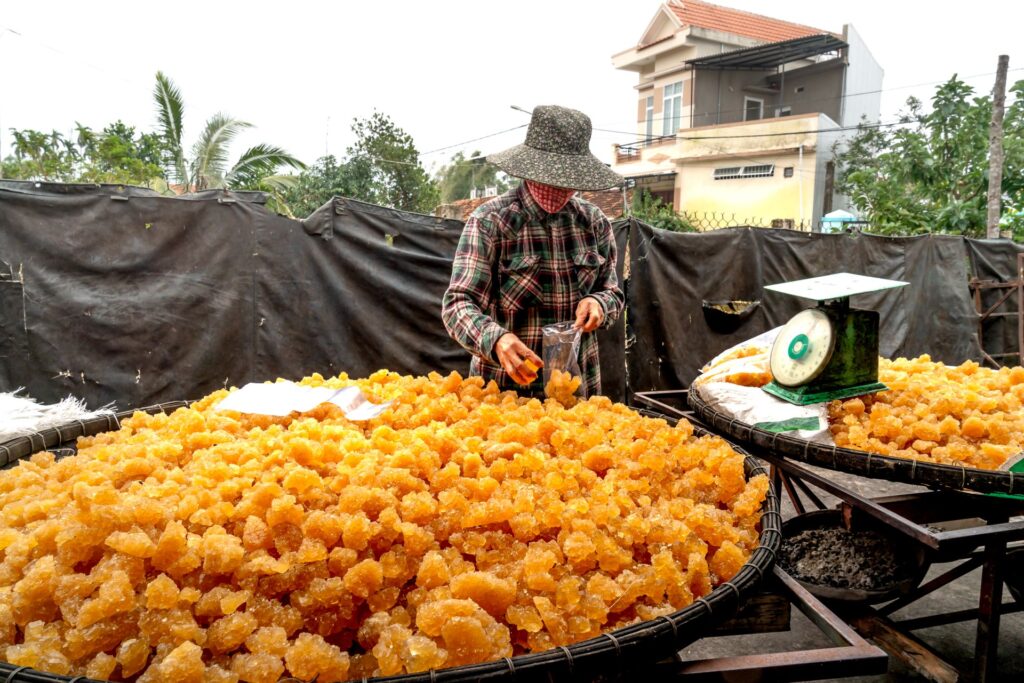
If you have ever wondered how jaggery is made — why it tastes so different from white sugar, why it carries that warm, caramel-like complexity — the answer lies entirely in a process that has remained unchanged for centuries. From the moment sugarcane is harvested in rural India to the point a golden block of jaggery lands in your kitchen, there is no factory machinery, no chemical refining, no bleaching agents. Just heat, tradition, and remarkable restraint. This guide walks you through the complete jaggery production process, step by step.
Where It All Starts: The Sugarcane Fields
The quality of jaggery is determined long before any fire is lit. It begins with the variety of sugarcane and the timing of the harvest. Traditional jaggery-making regions — Maharashtra, Karnataka, Uttar Pradesh, Tamil Nadu, and West Bengal — have been cultivating specific sugarcane varieties for jaggery production for generations.
Unlike sugarcane grown for white sugar, jaggery-grade cane is harvested at peak sucrose content, typically between November and April. The stalks must be processed within hours of cutting — sugar content in sugarcane degrades quickly once separated from the root. Most jaggery makers work close to the fields, and often through the night during harvest season.
This field-to-fire speed is one reason artisanal jaggery retains more of its natural molasses content, minerals, and trace nutrients compared to commercially refined sugar. If you are new to jaggery, our complete guide to what jaggery is covers the basics in depth.
How is Jaggery Made? The Step-by-Step Process
The jaggery making process follows six core stages. Each step matters and cannot be rushed without compromising quality.
1. Crushing and Juice Extraction
Freshly cut sugarcane is fed through a mechanical crusher — traditionally bullock-powered, now usually a motor-driven kolhu or mill. The crusher extracts raw sugarcane juice: a cloudy, pale green liquid that smells faintly of grass and sweetness. Every 100 kg of sugarcane yields roughly 50 to 60 litres of juice.
2. Clarification
Raw juice carries impurities — plant fibre, soil, and microorganisms. To remove them, the juice is transferred to large iron pans and heated gently. A small quantity of natural clarifying agents is added — most commonly dried bark of the bhindi (okra) plant, or lime water (chuna). These cause impurities to coagulate and rise as foam, which workers skim off continuously using large perforated ladles. Good jaggery uses only natural clarifiers. Chemical ones, such as sodium hydrosulphite, are a sign of industrial shortcutting.
3. Boiling and Concentration
Once clarified, the juice moves to wide, shallow boiling pans set over a firewood furnace. The fire is fed with bagasse — the fibrous sugarcane pulp left after crushing. This self-sustaining fuel loop is one reason traditional jaggery making has a remarkably low carbon footprint.
The juice is boiled at high heat — between 115°C and 120°C — while workers stir constantly using large wooden paddles. As moisture evaporates, the liquid reduces to roughly one-tenth of its original volume, thickening into a dense, dark amber syrup.
4. Testing for Readiness
Experienced makers test the syrup by dropping a small amount into a bowl of cold water. If it forms a firm ball that holds its shape, the jaggery is ready. If it dissolves or stays soft, it needs more time. This judgment — made entirely by eye and touch — cannot be easily replicated by automated systems. It is one of the defining skills in the jaggery production process.
5. Moulding
When the syrup reaches the right consistency, it is quickly transferred to moulds — shallow metal trays, rounded clay cups, or cylindrical forms, depending on the regional tradition. The hot syrup is poured and left to cool at room temperature, solidifying into the familiar blocks, rounds, or cones of jaggery.
6. Curing and Storage
Once set, the jaggery is removed from the moulds and left to cure in a dry, ventilated space for 12 to 24 hours. Properly made jaggery — with low moisture content — can be stored for months without refrigeration and without any added preservatives.
The Role of Temperature and Timing
The jaggery production process is extraordinarily sensitive to heat. Under-boiling results in a sticky, soft product that ferments quickly. Over-boiling produces dark, brittle jaggery with a bitter aftertaste. The window of perfection is narrow.
| Stage | Temperature Range | What Happens |
|---|---|---|
| Clarification | 60–70°C | Impurities rise and are skimmed |
| Initial boil | 100–110°C | Rapid moisture evaporation |
| Concentration | 115–120°C | Syrup thickens to final consistency |
| Moulding | 80–90°C | Poured while still fluid and pliable |
Experienced jaggery makers judge readiness entirely by the way the syrup threads when lifted on a ladle, its colour shift from pale gold to deep amber, and a characteristic crackling sound as it thickens. This sensory expertise is passed down through generations.
Traditional vs. Commercial Jaggery Production
Not all jaggery is made the same way. Understanding the difference helps you buy better.
- Traditional village method: Small batches, open pans, bagasse or wood fuel, natural clarifiers only. Produces darker, mineral-rich jaggery with complex flavour. This is what Biotag sources directly from farmers.
- Semi-commercial: Larger iron pans, motor-powered crushers, still additive-free. More consistent in colour and shape, but retains most of the nutritional value.
- Industrial: Uses chemical clarifiers such as sodium hydrosulphite and artificial colouring to produce a uniform, pale golden appearance. The resulting product looks “clean” but loses much of the nutritional depth — and the joy — of real jaggery.
Pale, perfectly uniform jaggery blocks are often a sign of chemical processing, not purity. If you are comparing your options, our deep dive into jaggery vs refined sugar explains exactly what gets lost in industrial processing.
The Different Forms Jaggery Takes
The same sugarcane juice, processed to different endpoints or shaped differently, yields several distinct jaggery products:
- Block jaggery: The most traditional form — dense, hard, requires grating or breaking before use. Long shelf life.
- Jaggery powder: Block jaggery that has been ground fine. Easier to measure and dissolves faster in hot liquids. Biotag Jaggery Powder is made from additive-free blocks, ground fresh without anti-caking agents or added starch.
- Liquid jaggery (rab): Boiling is stopped early, before the syrup solidifies fully. Used widely in Maharashtra as a condiment and sweetener for breads and rotis.
- Jaggery cubes: Portioned for convenience; identical in composition to blocks.
What Gives Jaggery Its Colour and Taste?
The colour of jaggery — ranging from pale gold to deep brown — depends on three factors: sugarcane variety, boiling duration, and whether chemical clarifiers were used.
Darker jaggery typically comes from more mature cane with higher molasses content, boiled longer. It has a richer, earthier flavour with hints of toffee and tamarind. Lighter jaggery is made from younger cane or processed with chemical agents, and tastes milder.
Darker jaggery also tends to retain more minerals — iron, potassium, magnesium, phosphorus — because these are concentrated in the molasses it retains. White sugar, by contrast, has had all molasses removed, taking those minerals with it entirely. For the full nutritional story, read our article on the proven health benefits of jaggery.
How to Identify Pure, Additive-Free Jaggery
Given how widely adulterated commercial jaggery can be, here is a quick buying checklist:
- Colour: Dark golden to medium brown is natural. Very pale yellow or neon gold often signals chemical treatment.
- Texture: Firm and slightly grainy when broken. Overly smooth or plastic-like texture is a red flag.
- Taste: Complex, slightly earthy, with a rich caramel finish. Flat, one-note sweetness suggests additives.
- Moisture: Good jaggery is dry to the touch. Excessive stickiness means it was under-boiled.
- Label: Look for “no added sugar”, “no preservatives”, “no artificial colour” — and ideally a mention of the production region or farm source.
Frequently Asked Questions
Is jaggery making the same as white sugar production?
No. Both start with sugarcane juice, but the processes diverge completely. White sugar production involves multiple chemical stages — clarification with lime, carbonation, sulphitation, decolourisation, and crystallisation — that strip away all molasses and most minerals. Jaggery is simply concentrated, clarified cane juice that retains its natural molasses. The minimal processing is exactly what sets it apart.
How long does it take to make jaggery?
From juice extraction to final moulded block, the entire jaggery making process typically takes 2 to 3 hours per batch, depending on batch size and fire intensity. Curing and drying after moulding takes an additional 12 to 24 hours.
Does jaggery contain any preservatives?
Traditionally made jaggery contains no preservatives. Its natural shelf life comes from low moisture content and high sugar concentration, which inhibit microbial growth. However, commercially produced jaggery often contains sodium metabisulphite or other chemical preservatives — always read the label.
Can jaggery be made from anything other than sugarcane?
Yes. Jaggery is also made from palm sap (palm jaggery), date palm sap (date palm jaggery), and coconut palm sap (coconut jaggery). The production process is similar — sap is boiled and concentrated — but the flavour profiles are very different. Palm jaggery has a smokier, more complex taste; coconut jaggery is lighter and slightly floral.
Why does jaggery sometimes have a sour taste?
A sour or fermented taste usually means the sugarcane juice was not processed quickly enough after extraction, or the jaggery has been stored in humid conditions and begun to ferment. Fresh, properly made and stored jaggery should have no sourness at all.
Is darker jaggery better than lighter jaggery?
Not necessarily better — but richer. Darker jaggery has more molasses, more minerals, and a more complex flavour. Very pale jaggery may have been chemically clarified. For everyday cooking and the best nutritional profile, medium to dark golden jaggery from a trusted, additive-free source is the right choice.
How should jaggery be stored at home?
Store jaggery in an airtight container at room temperature, away from direct sunlight and moisture. Jaggery powder is more hygroscopic than blocks and should be sealed tightly after opening and used within three to four months for best quality.
About the Author: The Biotag team works directly with traditional jaggery makers across Maharashtra, Karnataka, and Uttar Pradesh to bring you additive-free, lab-tested jaggery — crafted exactly as it has been made for centuries.