
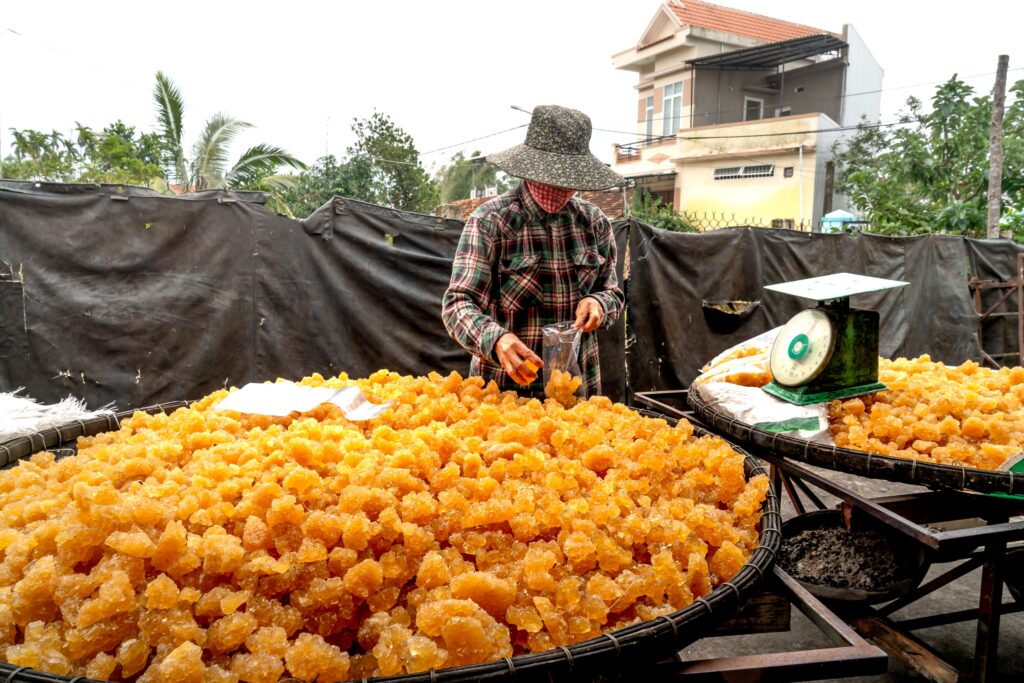
If you run a restaurant, catering business, sweet shop, or hotel kitchen in India, you already know that switching from refined sugar to jaggery on your menu is easy — finding reliable bulk jaggery suppliers who can deliver consistent quality, week after week, is the hard part. One batch tastes clean and caramel-forward, the next is gritty, too dark, or worse, cut with chalk or sugar syrup to bulk up the weight. For a home cook that’s an inconvenience. For a commercial kitchen ordering 25-100 kg a month, it’s a quality-control problem that shows up in every dish you serve.
This guide walks through exactly what restaurants and caterers should look for in a wholesale jaggery supplier, how sourcing and pricing work at volume, and how to build a relationship that protects your margins and your plate consistency.
Why Restaurants & Caterers Need a Dedicated Supplier
Retail jaggery — the kind sold in 500g packets at a supermarket — is priced and packaged for households, not commercial kitchens. Buying it in bulk from a general store means paying retail margins on every kilo, dealing with inconsistent stock, and often getting product that’s been sitting on a shelf for months. Working with dedicated bulk jaggery suppliers instead of a general grocer solves three problems at once:
- Consistency — the same colour, moisture level, and sweetness batch after batch, which matters enormously for standardised recipes.
- Cost — wholesale jaggery pricing drops meaningfully once you cross typical slab quantities (usually 10 kg and 25 kg tiers).
- Traceability — a real supplier can tell you which region and which farmer cluster your jaggery came from, and can produce lab test reports on request.
What to Check Before You Place a Bulk Order
Before signing on with any bulk jaggery india supplier, run through this checklist. It takes ten minutes and saves you from a bad batch landing in your kitchen mid-service.
| Check | Why it matters | What good looks like |
|---|---|---|
| Lab test report | Confirms no chemical whitening agents or added sugar syrup | Recent report (within 3-6 months), independent lab |
| Moisture content | High moisture jaggery spoils faster and clumps in storage | Under 8-10% for blocks and powder |
| Source transparency | Tells you if it’s genuinely small-batch or repackaged commodity stock | Named region/cluster, not just “India” |
| Minimum order quantity (MOQ) | Determines whether pricing actually beats retail | Flexible tiers starting around 5-10 kg |
| Packaging for commercial use | Retail pouches aren’t built for kitchen handling | Sealed bulk bags, easy-reclose options |
| Delivery reliability | A missed delivery mid-week disrupts your prep schedule | Defined lead times, repeat-order history |
How Wholesale Jaggery Pricing Actually Works
Jaggery pricing isn’t flat — it moves with sugarcane season, region, and processing method. A few things restaurant buyers should know:
- Seasonality: Fresh-season jaggery (roughly November to March in most cane-growing belts) is usually better quality and, counterintuitively, not always cheaper — demand spikes around the same window.
- Format changes the price per kg: Jaggery powder is typically priced slightly higher than blocks per kilo because of the extra processing, but it saves labour time in a kitchen since it dissolves faster — worth it if you’re making large batches of chai, gravies, or desserts.
- Volume tiers: Most legitimate wholesale jaggery suppliers offer a stepped discount — for example, standard pricing under 10 kg, a discount at 10-25 kg, and a further discount above 25 kg or on a standing monthly order.
- Liquid jaggery is a different cost curve: Because it’s shelf-stable and pre-dissolved, liquid jaggery syrup often works out cheaper per “usable” kilo for beverage-heavy menus — no melting, no straining out impurities.
For our own jaggery powder, premium jaggery blocks, and liquid jaggery syrup, bulk pricing is available on request for restaurants and caterers — each batch ships with its lab test summary so your kitchen team isn’t taking quality on faith.
Matching the Format to Your Menu
Not every bulk jaggery format suits every kitchen. Choosing the right one saves prep time as much as it saves money.
- Jaggery powder — best for chai, curries, marinades, and baking. Measures like sugar, dissolves fast, no chopping.
- Premium jaggery blocks — best for sweet shops and caterers making traditional mithai, where the block format is part of the process (grating, melting slowly for laddoos and payasam).
- Liquid jaggery syrup — best for beverage programs, dressings, and glazes where a pourable, pre-dissolved sweetener saves a step during service.
Many commercial kitchens actually run all three in parallel — powder for the line, blocks for the sweets counter, syrup for the beverage station.
Red Flags When Vetting Bulk Jaggery Suppliers
Because jaggery is one of the more commonly adulterated commodities in India, commercial buyers should be more cautious, not less, when ordering at volume from bulk jaggery suppliers. Watch for:
- Unusually uniform, bright yellow colour (often a sign of chemical whitening agents rather than natural variation).
- A supplier who can’t produce any lab documentation when asked directly.
- Pricing that’s dramatically below the going wholesale jaggery rate — quality corners are usually being cut somewhere.
- No fixed business address or GST details for a supposedly established supplier.
Genuine bulk jaggery suppliers won’t hesitate on any of the points above — hesitation itself is a signal worth paying attention to.
We’ve covered the consumer-facing version of this in detail in How to Spot Adulterated Jaggery: 7 Telltale Signs — the same checks apply, just at a larger scale, when you’re inspecting a sample sack before committing to a standing order.
Setting Up a Standing Order
Once you’ve vetted a supplier, most restaurants and caterers move to a standing or recurring order rather than placing one-off purchases. This is worth doing for three reasons:
- It locks in pricing for a defined period, protecting you from seasonal spikes.
- It guarantees a delivery slot, which matters when jaggery is a daily-use ingredient rather than an occasional one.
- It gives the supplier visibility into your demand, which usually improves batch consistency because they’re processing for a known buyer, not spot-selling.
A simple monthly or fortnightly cadence — matched to your average consumption — is usually enough. Most kitchens using jaggery daily in chai and gravies land somewhere between 15-40 kg a month depending on covers.
Storage & Shelf Life for Commercial Kitchens
Bulk jaggery storage is simple but easy to get wrong under kitchen conditions:
- Keep it in an airtight container away from direct heat sources (not next to the tandoor or stove line).
- Blocks and powder store well for 6-9 months at low moisture; refrigeration isn’t necessary and can actually introduce condensation.
- Liquid jaggery syrup should be kept sealed and used within the timeframe on the label once opened, much like any pourable syrup.
- If you notice white bloom or an off, overly sour smell, that batch should be discarded and flagged back to the supplier — it’s usually a moisture or storage issue, not a safety one, but it affects taste.
Frequently Asked Questions
What is the minimum order quantity for bulk jaggery suppliers?
It varies by supplier, but most wholesale jaggery programs start recognising commercial pricing tiers from around 5-10 kg, with better rates from 25 kg upward. Ask any prospective supplier for their tier structure before committing.
Is bulk jaggery cheaper than buying retail packets?
Almost always, yes. Retail packaging and retailer margins add meaningfully to the per-kilo cost. Buying bulk jaggery india-wide from a wholesale-focused supplier typically brings the cost down noticeably once you’re ordering in double-digit kilos.
How do I verify a bulk jaggery supplier is not adulterated?
Ask for a recent independent lab test report and check the colour and texture against what’s described in our guide on spotting adulterated jaggery. A trustworthy supplier will share this without hesitation.
Which jaggery format is best for a restaurant kitchen?
It depends on use. Powder is fastest for daily cooking and chai; blocks suit traditional mithai-making; liquid syrup suits beverage and dressing programs. Many kitchens stock more than one format.
How long does bulk jaggery last in commercial storage?
Properly stored in an airtight container away from heat and moisture, jaggery blocks and powder typically hold quality for 6-9 months.
Do bulk jaggery suppliers offer GST invoicing for restaurants?
Established suppliers should. This is worth confirming upfront if you need proper invoicing for your business accounts — it’s also a reasonable indicator of how formal and reliable the supplier’s operations are.
Can I get a sample before placing a large order?
Most reputable wholesale jaggery suppliers will provide a small sample or accept a modest first order so you can test the product in your kitchen before scaling up to a standing order.
If you’re comparing suppliers more broadly rather than sourcing purely at wholesale volume, our Best Jaggery Brands in India (2026 Buyer’s Guide) and Where to Buy Organic Jaggery Online in India cover the retail and small-batch side of the same sourcing questions.
About the Author: Aakash Chaudhary is the founder of Biotag — Natural Sweeteners, working with traditional jaggery makers and small-batch farmers across India to bring lab-tested, additive-free natural sweeteners to modern Indian households and commercial kitchens alike.