
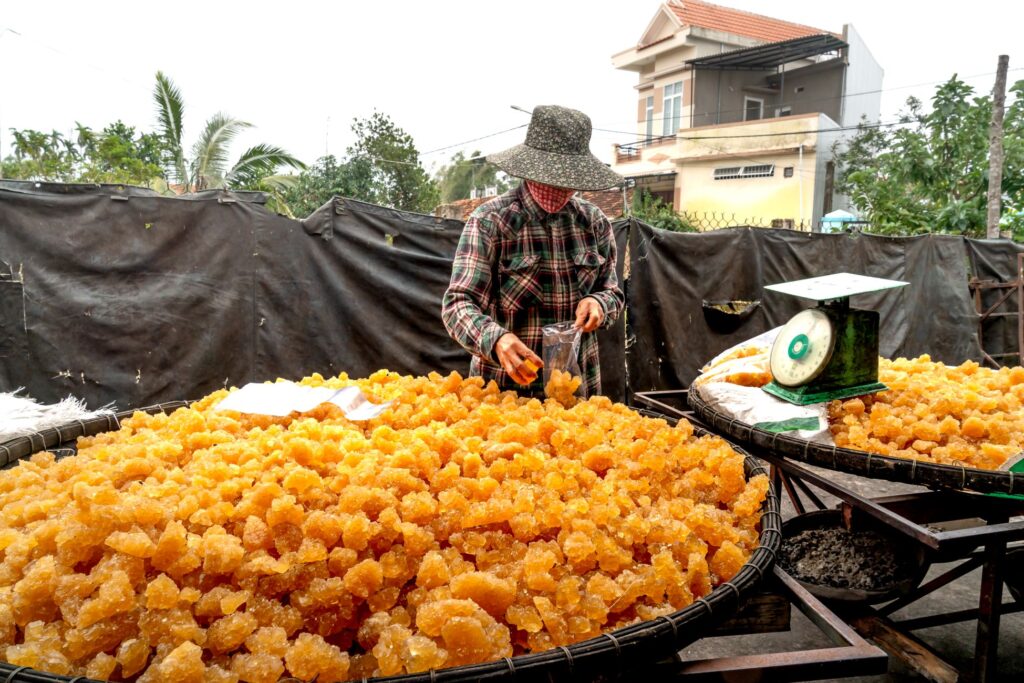
Walk into any South Indian grocery and you will find two very different-looking blocks of gur sitting side by side: the familiar golden cane jaggery and the darker, almost chocolate-brown palm jaggery. Most shoppers assume they are interchangeable. They are not. In this guide to palm jaggery vs cane jaggery, we pull together what published laboratory analyses actually report about sugars, minerals, moisture and glycaemic response, so you can choose the right sweetener for your kitchen and your health goals rather than relying on packaging claims.
What Are Palm Jaggery and Cane Jaggery?
To understand palm jaggery vs cane jaggery, start with how each is made. Both are unrefined, non-centrifugal sugars made by boiling a natural sap or juice until it thickens and sets. The difference lies in the raw material.
- Cane jaggery (gur) is made from freshly crushed sugarcane juice, boiled in wide iron or steel pans across Uttar Pradesh, Maharashtra, Karnataka and Tamil Nadu.
- Palm jaggery is made from the sap (neera) tapped from palm trees. In Tamil Nadu it comes from the palmyra palm and is called karupatti; in Bengal and Odisha it comes from the date palm and is sold as nolen gur or khejur gur.
If you are new to the palm variety, our explainer on what palm jaggery is and how to use it covers the basics. Here, we focus on the measurable palm jaggery difference that shows up when samples go to a food-testing lab.
Palm Jaggery vs Cane Jaggery: Sugar Composition
On sugar content, palm jaggery vs cane jaggery is closer than most people expect. Sugar makes up the bulk of both products, but the type of sugar differs. Sucrose is the dominant sugar in each, while reducing sugars (glucose and fructose) form a smaller share. Typical ranges reported in Indian food-science literature look like this:
| Parameter (per 100 g) | Cane jaggery | Palm jaggery |
|---|---|---|
| Sucrose | 65–85 g | 60–80 g |
| Reducing sugars | 5–15 g | 8–20 g |
| Moisture | 3–10 g | 5–12 g |
| Energy | approx. 380 kcal | approx. 360–375 kcal |
The takeaway in the palm jaggery vs cane jaggery comparison is that calorie counts are very close. Palm jaggery tends to carry slightly more moisture and reducing sugars, which partly explains its softer texture and deeper caramel flavour. Neither is a “low-calorie” sweetener, and portion size matters just as much with both.
Mineral Content: Where the Real Palm Jaggery Difference Lies
Minerals are where the two sweeteners separate most clearly. Because jaggery is not centrifuged, the minerals naturally present in the sap or juice stay in the final block. Our deeper look at the mineral profile of Indian jaggery explains how these values are measured.
| Mineral (per 100 g) | Cane jaggery | Palm jaggery |
|---|---|---|
| Potassium | 500–1,050 mg | 700–1,300 mg |
| Calcium | 40–100 mg | 80–170 mg |
| Magnesium | 70–90 mg | 60–110 mg |
| Iron | 2–11 mg | 2–10 mg |
| Phosphorus | 20–90 mg | 30–100 mg |
Two points are worth noting. First, ranges are wide because soil, season, sap quality and boiling method all shift the numbers. Second, iron values for both products are strongly influenced by the cooking vessel; jaggery boiled in traditional iron kadhais picks up noticeably more iron. On balance, in any palm jaggery vs cane jaggery mineral comparison, palm jaggery often edges ahead on potassium and calcium, while the iron gap is smaller than many blogs claim.
Keep the scale in perspective, though: the palm vs sugarcane jaggery gap shrinks further once serving size is considered. A typical serving is 10–15 g, so even the higher palm figures deliver a modest contribution to your daily needs. Jaggery is a better sweetener than refined sugar, not a mineral supplement.
Glycaemic Index and Blood Sugar Response
This is the question we hear most often in the palm vs sugarcane jaggery debate. Cane jaggery is generally cited with a high glycaemic index, often in the 80s, because it is mostly sucrose. Palm jaggery is frequently described as lower-GI, with some sources quoting figures around 40–50.
Be cautious with those numbers when judging palm jaggery vs cane jaggery for blood sugar. Very few rigorous, human-tested GI studies exist for palm jaggery, and many quoted values trace back to marketing material rather than clinical trials. What is reasonable to say is that palm jaggery’s slightly higher fibre-like solids and different sugar balance may produce a gentler rise for some people. For anyone managing diabetes, both should be treated as sugar. Our glycemic index chart of Indian sweeteners puts these figures alongside honey, khaandsari and date syrup.
Taste, Texture and Cooking Performance
Lab numbers aside, the palm jaggery vs cane jaggery choice often comes down to flavour and how each behaves on the stove.
- Flavour: Cane jaggery is sweet, buttery and mildly caramel. Palm jaggery is smoky, earthy and slightly salty, with notes some people compare to dark chocolate or coffee.
- Texture: Cane jaggery can be hard or crumbly; Biotag jaggery powder removes the grating step entirely. Palm jaggery is softer and stickier because of its higher moisture.
- Dissolving: Both dissolve readily in warm liquids, but palm jaggery melts faster and blends smoothly into milk-based sweets.
- Best uses: Cane jaggery suits chai, chikki, laddoos and dal. Palm jaggery shines in payasam, rasgulla, sandesh, pithe and coffee.
If you want to try palm jaggery in a classic dessert, our palm jaggery payasam recipe is a good starting point.
Purity, Adulteration and What to Check
Because genuine palm jaggery is costlier and seasonal, it is more prone to adulteration. Some sellers blend in cane jaggery or refined sugar and add colour to mimic the darker shade. When comparing palm vs sugarcane jaggery on the shelf, look for:
- A clear statement of the palm source (palmyra or date palm)
- No added sugar, colour or sodium hydrosulphite (a common clarifying chemical)
- Natural colour variation between batches rather than a uniform, glossy brown
- A slightly smoky aroma; pure cane jaggery smells sweeter and lighter
Biotag date palm jaggery is sourced from traditional tappers and made without chemical clarifiers, so the flavour and colour come only from the sap.
Price and Availability in India
Cost is the most visible gap between palm jaggery vs cane jaggery. Expect to pay a premium for palm jaggery. Cane jaggery typically retails between ₹80 and ₹200 per kg depending on quality and form, while genuine palm jaggery ranges from roughly ₹300 to ₹700 per kg. The difference reflects how labour-intensive tapping is and the short winter season for date palm sap. Cane jaggery is available year-round in every region, which makes it the practical daily choice for most households.
Palm Jaggery vs Cane Jaggery: Which Should You Choose?
There is no single winner. Choose based on use and priorities:
- Choose cane jaggery for everyday chai, cooking and baking where cost and availability matter, ideally as easy-to-measure jaggery powder.
- Choose palm jaggery for festive sweets, milk desserts and coffee where its smoky depth adds character, or if you want a slightly higher potassium and calcium contribution.
- Use either sparingly if you are watching blood sugar or weight.
Ultimately, palm jaggery vs cane jaggery is less a contest than a pairing. Many Indian kitchens simply keep both: cane for daily use and palm for special occasions.
Frequently Asked Questions
In the palm jaggery vs cane jaggery comparison, which is healthier?
Palm jaggery often contains somewhat more potassium and calcium, and may cause a gentler blood sugar rise, but the difference is modest. Both are unrefined sugars and should be eaten in moderation.
What is the main palm jaggery difference in taste?
Palm jaggery tastes smoky, earthy and slightly salty, while cane jaggery is sweeter and more caramel-like.
Can diabetics eat palm jaggery instead of cane jaggery?
Palm jaggery is still sugar. Some people tolerate it slightly better, but diabetics should consult their doctor and keep portions small regardless of type.
Does palm jaggery have more iron than cane jaggery?
Not consistently. Iron levels in both depend heavily on whether they are boiled in iron pans, so the palm vs sugarcane jaggery iron gap is usually small.
Why is palm jaggery more expensive?
Sap tapping is manual, yields are low and the date palm season lasts only a few winter months, which raises production costs.
Can I substitute palm jaggery for cane jaggery in recipes?
Yes, usually one-for-one by weight. Expect a darker colour, smokier flavour and slightly softer set in sweets like chikki.
About the Author: Aakash Chaudhary is the founder of Biotag, working with traditional jaggery makers and small-batch farmers across India to bring lab-tested, additive-free natural sweeteners to modern Indian households.