
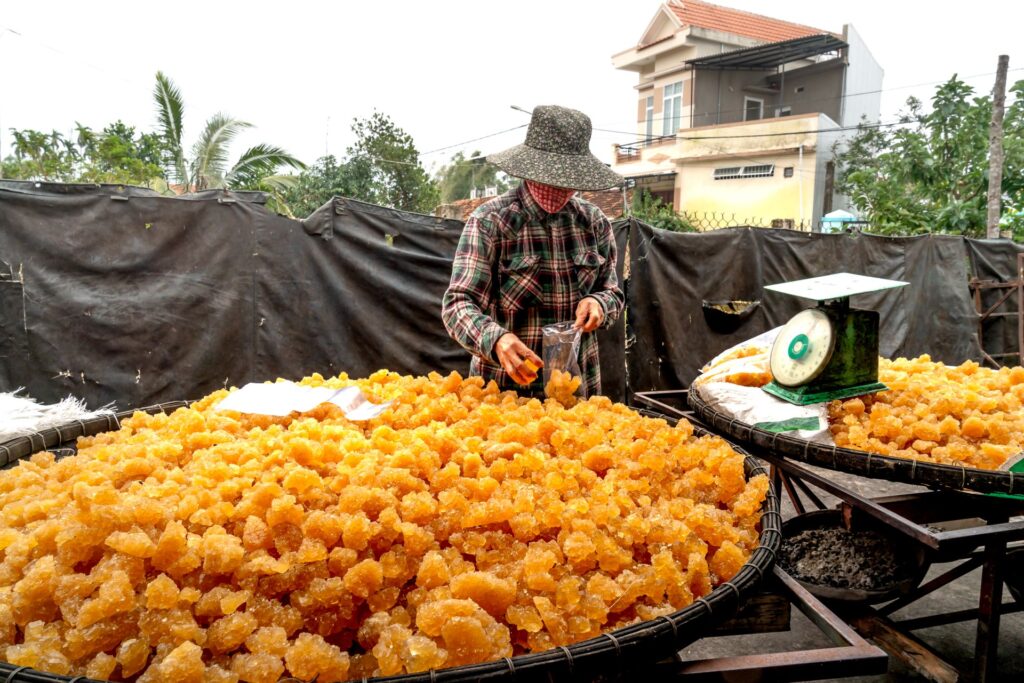
Every jaggery packet in India seems to promise “rich in minerals”, but very few tell you which minerals, how much, or how that compares with what your body actually needs. This guide looks at the real jaggery minerals content reported in Indian laboratory analyses, explains why the numbers vary so much from one batch to another, and shows you how to read them honestly. If you have ever wondered whether a spoon of gur in your chai is doing anything beyond sweetening it, the data below will give you a clear, evidence-based answer.
Why Jaggery Keeps Its Minerals When White Sugar Does Not
Jaggery and white sugar start from the same sugarcane juice. The difference lies in what happens next. Refined sugar goes through clarification, centrifuging and crystallisation that strip away almost everything except sucrose. Jaggery, on the other hand, is simply boiled down in open pans until the juice thickens and sets. Nothing is spun off, so the minerals the cane pulled from the soil stay in the final product.
That is the whole reason jaggery is called a “non-centrifugal sugar” in research papers. The molasses fraction, which carries potassium, magnesium, calcium and iron, is retained. White sugar, by contrast, contains only trace amounts of any mineral. If you want the full story of the boiling process, our guide on how jaggery is made from farm to kitchen walks through each stage.
Jaggery Minerals Content: The Lab-Tested Numbers
The table below summarises the jaggery minerals content most often reported in Indian research on non-centrifugal cane sugar. Values are per 100 g and are shown as ranges, because lab results genuinely differ between regions, cane varieties and processing methods. Treat these as typical published ranges, not a guarantee for any single block.
| Mineral | Typical range per 100 g | Per 10 g serving (approx.) | Main role in the body |
|---|---|---|---|
| Potassium | 600 to 1,050 mg | 60 to 105 mg | Fluid balance, nerve and muscle function |
| Magnesium | 70 to 90 mg | 7 to 9 mg | Energy metabolism, muscle relaxation |
| Calcium | 40 to 100 mg | 4 to 10 mg | Bones, teeth, nerve signalling |
| Phosphorus | 20 to 90 mg | 2 to 9 mg | Bones, energy (ATP) production |
| Sodium | 19 to 30 mg | 2 to 3 mg | Fluid balance |
| Iron | 5 to 13 mg | 0.5 to 1.3 mg | Haemoglobin and oxygen transport |
| Manganese | 0.2 to 0.5 mg | 0.02 to 0.05 mg | Antioxidant enzymes |
| Zinc | 0.2 to 0.4 mg | 0.02 to 0.04 mg | Immunity, wound healing |
| Copper | 0.1 to 0.9 mg | 0.01 to 0.09 mg | Iron metabolism, connective tissue |
For comparison, refined white sugar typically shows less than 2 mg of potassium and well under 1 mg of calcium per 100 g. In other words, jaggery nutrition data and white sugar data are not even in the same category for minerals.
How to Read Jaggery Nutrition Data Without Being Misled
Numbers per 100 g look impressive, but nobody eats 100 g of jaggery in a day. A realistic serving is 10 to 15 g, roughly one to two teaspoons of powder or a small cube. When you scale the jaggery minerals content down to that amount, the picture becomes more modest:
- Potassium: a 10 g serving gives about 2 to 3% of an adult’s daily requirement.
- Magnesium: roughly 2 to 3% of daily needs.
- Iron: between 3% and 7% of the ICMR recommendation for adult women, depending on the batch.
- Calcium: around 1% of daily needs.
So the honest summary of jaggery nutrition data is this: jaggery is a meaningfully better sweetener than white sugar, but it is still a sweetener, not a supplement. It adds small, useful amounts of minerals to food you were going to sweeten anyway. That is a real benefit, and it is the right way to think about it.
What Changes the Jaggery Mineral Profile From Batch to Batch
If you compare two lab reports, you may see iron at 5 mg in one and 12 mg in another. That spread is normal. The jaggery mineral profile depends on several factors:
- Soil and region. Cane grown in mineral-rich black soils of Maharashtra and Karnataka often tests differently from cane grown in the alluvial plains of Uttar Pradesh.
- Cane variety and maturity. Fully mature cane carries more dissolved solids, including minerals.
- Clarification method. Traditional makers use plant-based clarifiers such as deola (okra mucilage). Chemical clarifiers like hydros (sodium hydrosulphite) can alter colour and add sulphite residues.
- Pan material. Jaggery boiled in iron kadhais is often reported to pick up extra iron from the vessel, which partly explains why some samples show much higher iron.
- Moisture content. Wetter jaggery has slightly lower mineral concentration per gram simply because water dilutes it.
Because the jaggery mineral profile is so sensitive to these variables, any brand that prints one fixed iron figure without context is oversimplifying.
The Three Minerals That Matter Most: Iron, Potassium and Magnesium
Iron
Iron gets the most attention, and for good reason, since anaemia remains widespread in India. Jaggery does contribute some non-heme iron, though absorption is lower than from meat sources. Pairing jaggery with vitamin C-rich foods such as amla, lemon or guava improves uptake. We cover this in depth in our article on the iron content in jaggery and what research says.
Potassium
Potassium is actually the most abundant mineral in jaggery minerals content data. It supports healthy blood pressure by balancing sodium. People with kidney disease who are on a potassium-restricted diet should check with their doctor before eating jaggery regularly.
Magnesium
Magnesium supports hundreds of enzyme reactions, including those that turn food into energy. The magnesium in jaggery is one reason traditional Ayurvedic practice recommends a small piece after meals to ease digestion and fatigue.
Jaggery Minerals Content Compared With Other Sweeteners
How does the jaggery minerals content stack up against other common sweeteners in Indian kitchens? The table below uses typical published values per 100 g.
| Sweetener | Potassium (mg) | Iron (mg) | Calcium (mg) | Magnesium (mg) |
|---|---|---|---|---|
| Cane jaggery | 600 to 1,050 | 5 to 13 | 40 to 100 | 70 to 90 |
| Date palm jaggery | 400 to 1,000 | 2 to 10 | 50 to 300 | 30 to 90 |
| Honey | 50 | 0.4 | 6 | 2 |
| Brown sugar | 130 | 0.7 | 80 | 30 |
| White sugar | 2 | 0.05 | 1 | 0 |
Cane jaggery and date palm jaggery are clearly the most mineral-dense options. Date palm jaggery, known as nolen gur in Bengal, often tests higher for calcium, while cane jaggery tends to lead on potassium. If you want to know more about palm-based gur, read what palm jaggery is and how to use it.
How to Choose Jaggery With a Reliable Mineral Profile
You cannot run a lab test at home, but you can stack the odds in your favour:
- Look for chemical-free processing. Avoid jaggery made with hydros or other bleaching agents. These can reduce quality and leave residues.
- Do not chase a bright golden colour. Natural jaggery is usually darker brown. Very pale jaggery is often chemically lightened.
- Ask for lab reports. Reputable brands should be able to share mineral and contaminant testing on request.
- Check for adulteration. Chalk powder and washing soda are sometimes added to increase weight. Our guide on how to spot adulterated jaggery lists simple home tests.
Biotag’s jaggery powder is made without chemical clarifiers and dissolves easily in chai, milk and batters, so you get the full jaggery minerals content in an everyday format.
Frequently Asked Questions
What is the jaggery minerals content per 100 g?
Published lab data shows roughly 600 to 1,050 mg potassium, 70 to 90 mg magnesium, 40 to 100 mg calcium, 5 to 13 mg iron and small amounts of zinc, copper and manganese per 100 g. Exact values vary by region and processing.
Is jaggery a good source of iron?
It is a modest source. A 10 g serving provides around 0.5 to 1.3 mg of iron. That helps, but jaggery alone cannot treat anaemia. Pair it with vitamin C-rich foods and a balanced diet.
Does jaggery powder have the same minerals as jaggery blocks?
Yes, broadly. Powder is made from the same boiled cane juice and keeps a similar jaggery mineral profile. Small differences come from moisture content rather than the format itself.
Which has more minerals, cane jaggery or date palm jaggery?
Both are mineral-rich. Cane jaggery usually has more potassium and iron, while date palm jaggery often shows higher calcium. The choice can come down to taste and how you plan to use it.
Can diabetics eat jaggery for its minerals?
Jaggery still raises blood sugar much like regular sugar. Diabetics should limit portions and consult their doctor. The mineral benefit does not cancel out the sugar load.
Does cooking destroy the minerals in jaggery?
No. Minerals are stable under heat, so jaggery used in kheer, laddus or chai keeps its jaggery minerals content. Some vitamins and antioxidants may reduce with heat, but minerals do not.
The Bottom Line
The jaggery minerals content is real and measurable, led by potassium, magnesium, calcium and iron. It makes jaggery a smarter everyday sweetener than white sugar, especially for Indian households that sweeten chai, dal and desserts daily. Just keep expectations realistic: enjoy it in moderation, choose chemical-free jaggery, and let your overall diet do the heavy lifting. For more on the wider benefits, see our evidence-based guide to the health benefits of jaggery.
About the Author: Aakash Chaudhary is the founder of Biotag, working with traditional jaggery makers and small-batch farmers across India to bring lab-tested, additive-free natural sweeteners to modern Indian households.